For the vast majority of the global population, the electricity grid is an “invisible giant.” It is a machine so massive and so reliable that we only acknowledge its existence in the rare moments it fails. We flip a switch, plug in a smartphone, or start a dishwasher with a subconscious expectation of instant, infinite power. Yet, behind every flickering LED and hum of a refrigerator lies the most complex, real-time balancing act in human history.
Building a reliable energy grid is like conducting a massive, 24/7 orchestra where the music can never stop. To understand how the “concert” of the modern energy transition stays in tune, we need to meet the two most important conductors: TSO & DSO.
A Transmission System Operator (TSO) manages the high-voltage “energy highways” that move bulk power over long distances, while a Distribution System Operator (DSO) controls the “local streets” that deliver electricity to homes. As we move toward a decentralized grid powered by renewables, these two entities are shifting from physical infrastructure owners to digital orchestrators, using AI and automation to manage two-way power flows and maintain grid stability in a world without traditional fossil-fuel inertia.
In this guide, we’ll break down what these operators do, how they work together, and why the “digital revolution” is the only thing keeping the lights on.
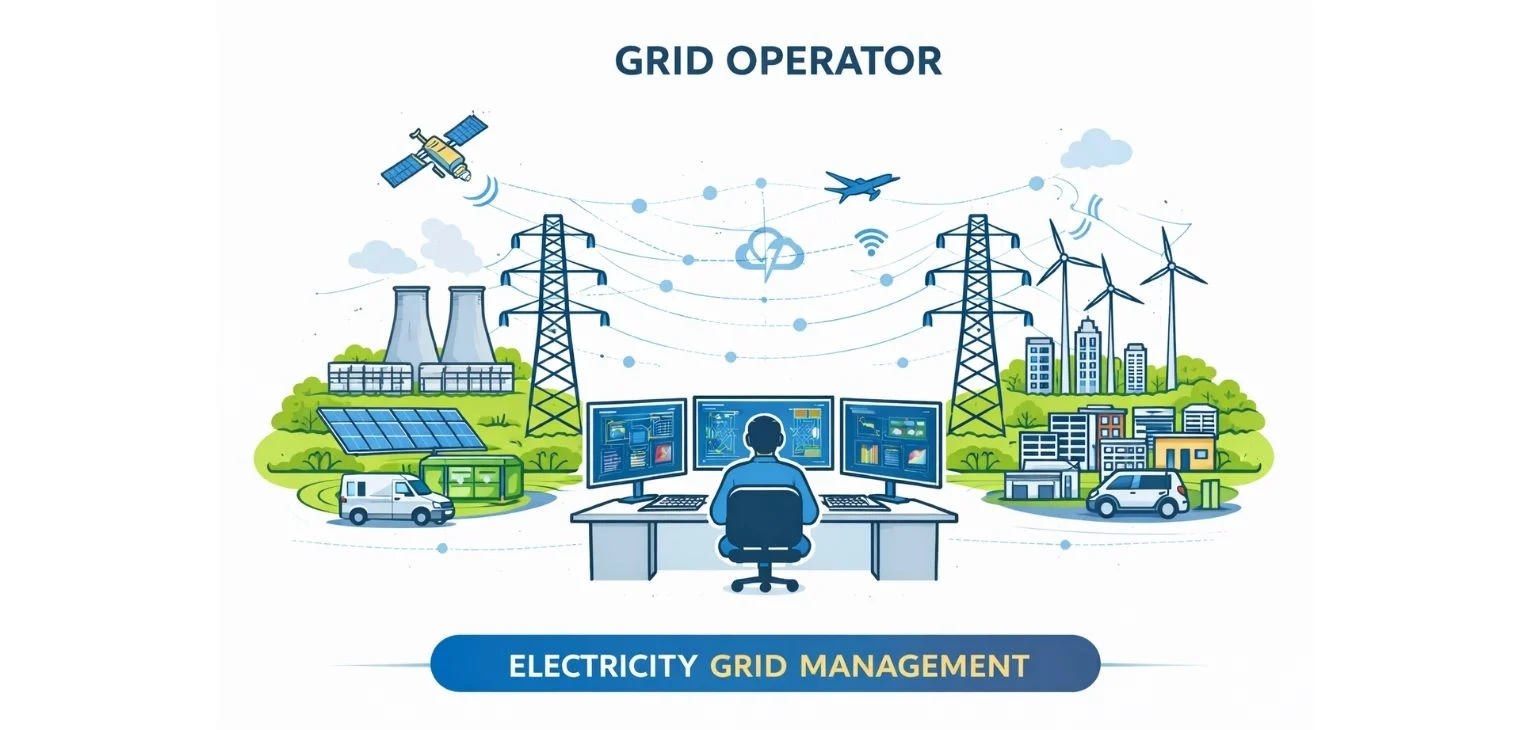
What is a Grid Operator?
A grid operator is a neutral administrative body responsible for the physical reliability and real-time balancing of an electrical network. They synchronize the injection of power from generators with the instantaneous withdrawal of energy by consumers, ensuring the grid maintains a constant frequency and voltage to prevent equipment damage or blackouts.
Imagine a grid operator as a master conductor of an orchestra where the instruments (power plants) are located hundreds of miles apart, and the audience (consumers) changes the volume of the music every second. The conductor doesn’t play an instrument; they ensure the tempo (frequency) never speeds up or slows down, preventing the music from falling into chaos.
Grid operators must solve the Power Flow Equation in real-time. Unlike water or gas, electricity travels at nearly the speed of light and cannot be “buffered” within the wires themselves. The operator uses State Estimation software to take millions of sensor snapshots per minute, allowing them to adjust Active Power to maintain frequency (50/60Hz) and Reactive Power to stabilize voltage levels across the system.
Roles and Responsibilities of a Grid Operator
While TSOs and DSOs have specific geographic and voltage jurisdictions, the “Grid Operator” function represents the administrative and operational “brain” of the energy system. Their mandate focuses on system security and operational stability.
-
Real-Time Supply and Demand Balancing:
The most fundamental task is ensuring that electricity generation matches consumption at every microsecond. They monitor the “System Frequency” and send signals to power plants to ramp up or down to keep the heartbeat of the grid steady.
-
Operational Security and Reliability:
They ensure the system operates within safe technical limits. This involves managing “Contingency Analysis” (the N-1 rule), ensuring that if a major component fails, the rest of the system remains stable and prevents a cascading blackout.
-
Ancillary Services Management:
The Grid Operator procures and activates “backup” services like frequency restoration, voltage support, and black-start capabilities. These are the tools used to stabilize the grid during sudden disruptions.
-
Market Orchestration and Fairness:
They act as an impartial referee in the energy market. They ensure that all market participants (from massive nuclear plants to small wind farms) have non-discriminatory access to the grid and that the cheapest available energy is prioritized (Economic Dispatch).
-
Congestion and Flow Management:
They monitor the physical “pressure” on the lines. If a specific path is overloaded with too much electricity, the operator will “redispatch” power (telling plants in one area to turn down and plants in another to turn up) to protect the hardware from melting or tripping.
-
Outage Coordination and System Recovery:
They are the central command during emergencies. If a storm knocks out a line, the Grid Operator coordinates the rerouting of power and manages the “restoration sequence” to bring customers back online safely and quickly.
-
Data and Transparency Provision:
They provide a unified data hub for the energy system. This includes publishing real-time data on demand, generation mix (renewables vs. fossil fuels), and market prices, which is essential for traders and policymakers.
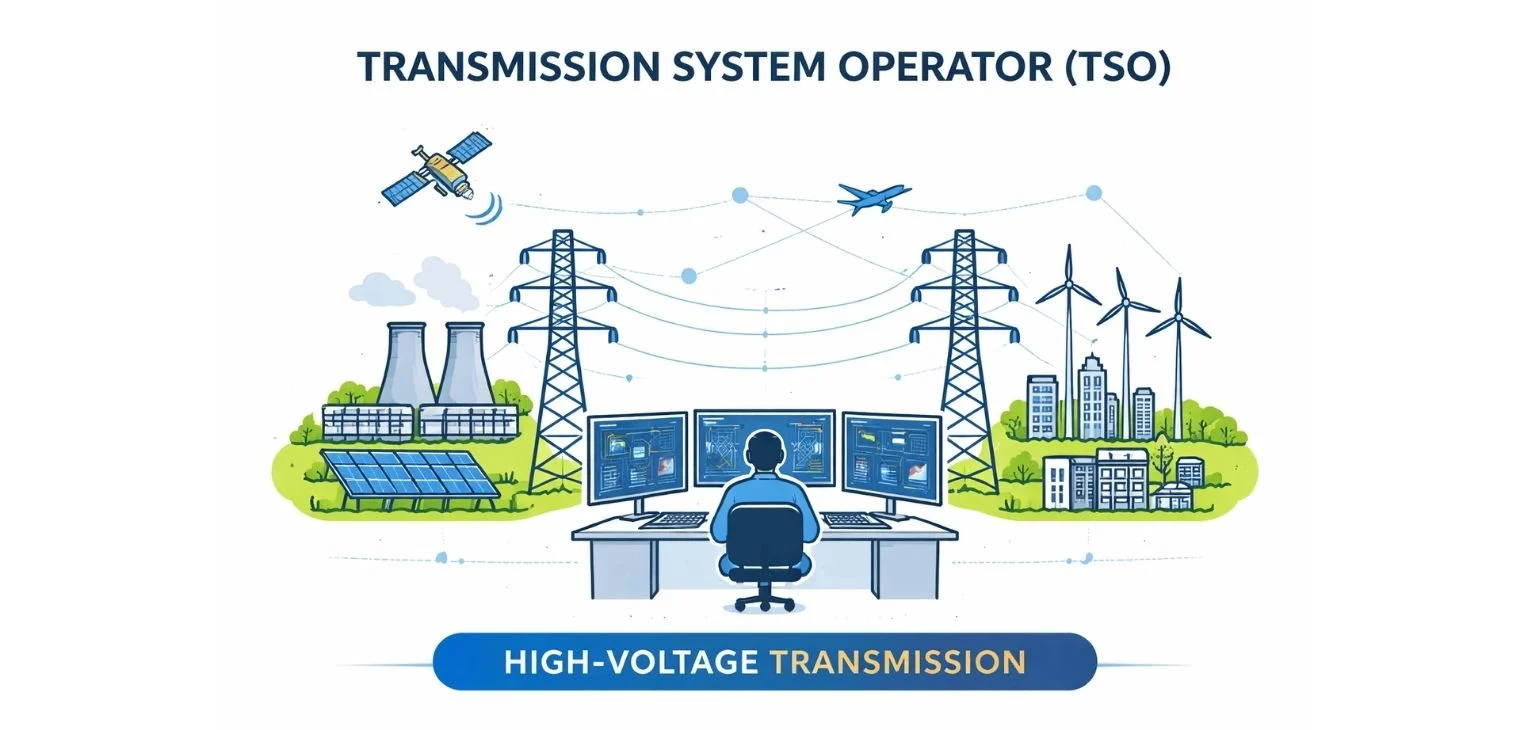
What is a Transmission System Operator (TSO)?
A Transmission System Operator (TSO) is the entity that manages the high-voltage “backbone” of the power system (typically 220kV to 400kV+). TSOs are responsible for the bulk transport of energy across vast regions or borders, maintaining national security of supply and facilitating the wholesale energy market through a neutral, unbundled business model.
If the grid is a human body, the Transmission System Operator (TSO) is the central nervous system. They manage the “Extra-High Voltage” lines that act as the arteries of the nation. Because they oversee such massive flows of energy, TSOs are usually natural monopolies regulated by the state. Their primary job is “System Security,” making sure that even if a major power plant or a subsea interconnector fails, the rest of the country stays powered.
How Do Transmission System Operators (TSOs) Work?
TSOs maintain a constant equilibrium between energy generation and consumption. Ancillary services operate across different time scales to achieve this: Frequency Containment Reserve (FCR) provides immediate response within seconds, while automatic and manual Frequency Restoration Reserves (aFRR and mFRR) act over longer horizons to restore system balance. By managing these reserves and cross-border interconnectors, TSO’s ensure the grid’s heartbeat stays at a stable 50Hz.
A TSO operates like a national air traffic control center for electrons. Using SCADA (Supervisory Control and Data Acquisition) systems, they have a real-time map of every massive power plant and high-voltage line in the country. Their primary operating principle is the N-1 Reliability Criterion. This means the grid must be configured so that if any single major pylon, transformer, or plant fails, the rest of the system can absorb the sudden shock without causing a wider blackout.
The TSO’s primary tool is Load-Frequency Control (LFC). They manage a tiered response system to stabilize the grid. When a generation imbalance occurs, FCR (Frequency Containment Reserve) provides an immediate, decentralized response via governor droop. Simultaneously, the TSO’s central controller calculates the Area Control Error (ACE) and sends automated signals via aFRR (automatic Frequency Restoration Reserve) to specific assets to ramp output up or down. This restores the frequency to its setpoint and allows the FCR assets to reset for the next event.
What are the Roles and Responsibilities of Transmission System Operators (TSOs)?
The TSO is the ultimate guardian of national energy security. Operating the high-voltage “backbone” of the grid (typically 220kV to 400kV or higher), their primary focus is on the macro-stability of the entire system.
-
Frequency Containment & Restoration:
The TSO’s most critical task is maintaining the grid’s “heartbeat” (50Hz in Europe, 60Hz in the US). If a large power plant fails, the TSO must deploy ancillary services in milliseconds to prevent a total system collapse.
-
National & International Energy Transport:
They manage the long-distance transmission lines and subsea interconnectors that allow electricity to flow between different regions and neighboring countries.
-
Wholesale Market Facilitation:
As a neutral, “unbundled” entity, the TSO provides the platform where large-scale power producers sell energy to suppliers, ensuring non-discriminatory access to the high-voltage wires.
-
Congestion Management at Scale:
They monitor the thermal limits of massive transmission lines, rerouting power flows if specific corridors become overloaded to prevent hardware damage.
-
Long-Term Infrastructure Planning:
TSOs are responsible for the “Ten-Year Network Development Plans,” deciding where to build new high-voltage lines to connect offshore wind farms or industrial hubs to the rest of the nation.
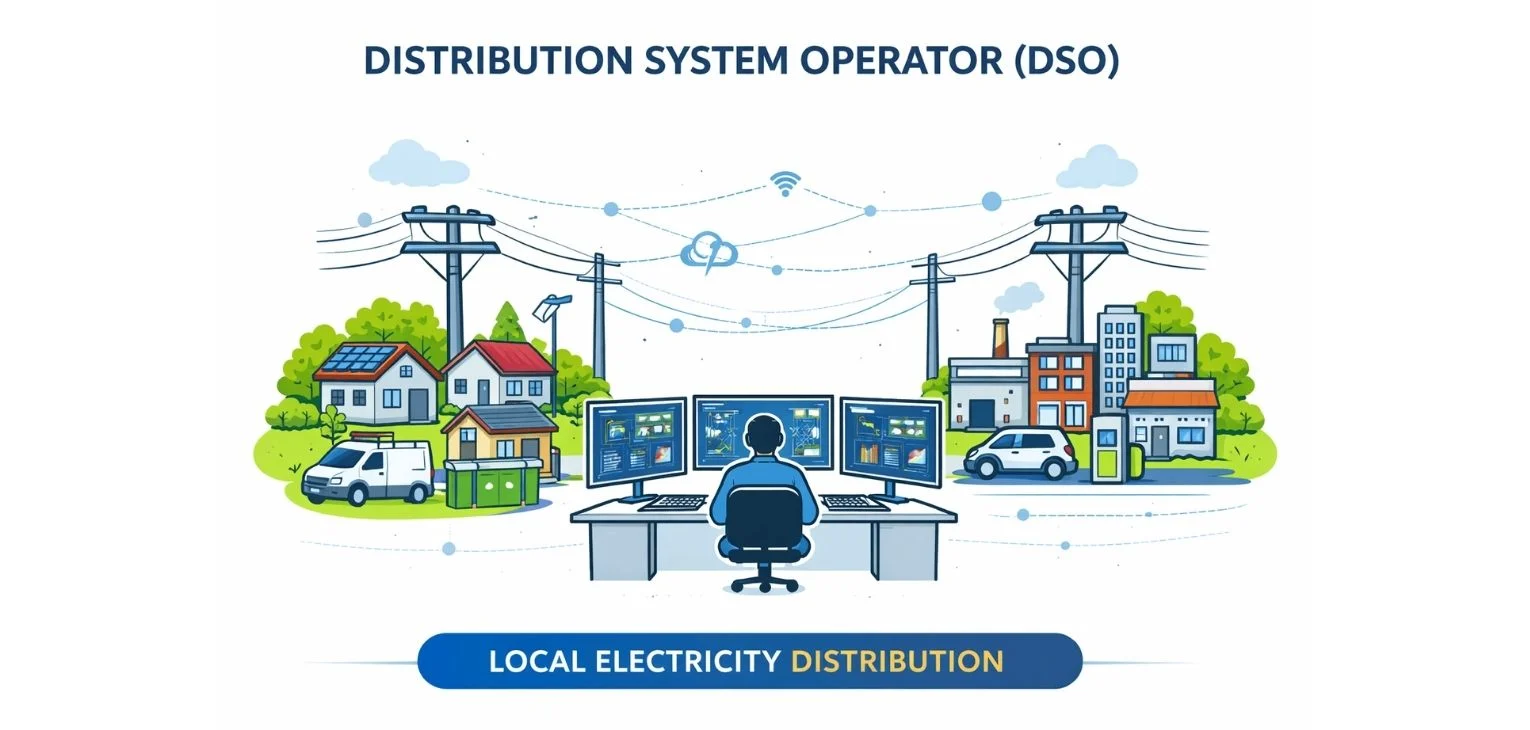
What is a Distribution System Operator (DSO)?
A Distribution System Operator (DSO) is the manager of the medium-to-low voltage network that delivers electricity to the final meter. DSOs take power from TSO substations, “step it down” to safer levels (e.g., 230V or 110V), and maintain the local infrastructure such as utility poles, street-level transformers, and smart meters.
If the TSO is the interstate highway, the DSO is the city planning department. They are the “last mile” providers. Traditionally, their job was simple: keep the wires up. Today, however, they are becoming Active System Managers. With the explosion of EVs and rooftop solar, the DSO has to manage “neighborhood congestion.” If ten neighbors all fast-charge their Teslas at 6 PM while the sun goes down, the DSO’s local transformer could overheat without smart digital intervention.
Modern DSOs are implementing ADMS (Advanced Distribution Management Systems) to gain “Edge Visibility.” They use OLTC (On-Load Tap Changers) at local substations to adjust voltage dynamically. This is crucial because when neighborhood solar panels produce too much power, they can push the local voltage too high, potentially damaging household appliances.
How Do Distribution System Operators (DSOs) Work?
Distribution System Operators (DSOs) work by managing the lower-voltage “last-mile” networks that deliver electricity from TSO substations to homes and businesses. They are responsible for local infrastructure maintenance, voltage regulation, and the integration of local renewable sources like rooftop solar and electric vehicle (EV) charging stations.
Historically, DSOs were “passive” delivery services. They built the lines and waited for people to use power. Today, they are “Active Network Managers.” Their biggest challenge is Voltage Management. If a neighborhood produces a massive amount of solar energy at noon, the “pressure” (voltage) on the local lines rises. If it gets too high, it can fry home electronics. The DSO must use smart transformers and data from smart meters to keep this voltage within a safe window.
DSOs utilize ADMS (Advanced Distribution Management Systems) to oversee complex radial or mesh networks. They handle local Congestion Management by utilizing “Flexible Connection Agreements.” For example, if the thermal capacity of a neighborhood cable is reached due to too many EVs charging, the DSO can temporarily throttle the charging rate. They also manage Phase Balancing, ensuring that the load is distributed evenly across the three phases of the local power lines to prevent transformer inefficiency and heat damage.
What are the Roles and Responsibilities of Distribution System Operators (DSOs)?
The DSO is the local architect of the energy transition. They manage the medium-to-low voltage networks (ranging from 110V up to 35kV) that deliver electricity directly to residential and commercial meters.
-
Last-Mile Delivery & Maintenance:
The DSO is responsible for the physical upkeep of utility poles, underground cables, and street-level transformers in your specific community.
-
Local Voltage Regulation:
Unlike the TSO, who focuses on frequency, the DSO focuses on “pressure” (voltage). They ensure the electricity entering your home stays within safe limits, preventing spikes that could damage household electronics.
-
Integration of Distributed Energy (DERs):
DSOs are the primary managers of the “two-way street.” They coordinate the connection of rooftop solar panels and home batteries, ensuring that local generation doesn’t overwhelm the neighborhood’s electrical capacity.
-
EV Infrastructure Management:
As electric vehicle adoption grows, DSOs must manage the sudden, high-power demand from home chargers to ensure local transformers do not overheat during peak evening hours.
-
Smart Metering & Data Orchestration:
DSOs manage the flow of consumption data from smart meters, providing the transparency needed for billing and for identifying local faults before customers even report them.
TSO vs DSO: What Is the Difference?
The main difference between a TSO and a DSO is the voltage level and scope of responsibility. A Transmission System Operator (TSO) manages the high-voltage transmission grid that transports electricity over long distances between power plants and regions. A Distribution System Operator (DSO) operates the medium- and low-voltage networks that deliver electricity directly to homes, businesses, and local industries.
| Feature | Transmission System Operator (TSO) | Distribution System Operators (DSOs) |
|---|---|---|
| Voltage Scale | 220,000V – 400,000V+ | 230V – 35,000V |
| Geographic Scope | National / International | Regional / Municipal |
| Stability Focus | Frequency & Bulk Balancing | Voltage & Local Congestion |
| Asset Type | Large Pylons, Massive Substations | Utility Poles, Underground Cables |
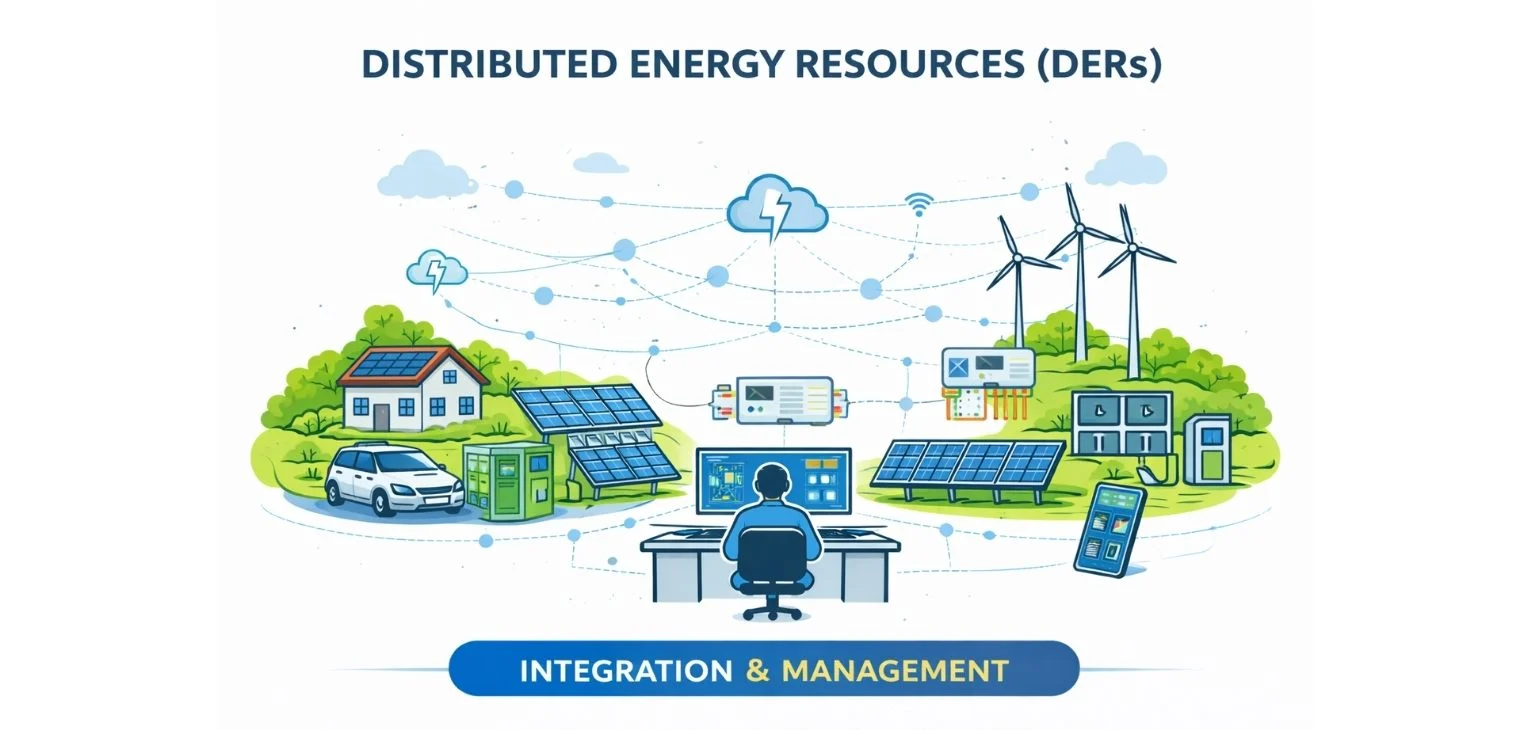
What are Distributed Energy Resources (DERs)?
Distributed Energy Resources (DERs) are small-scale energy units located on the consumer side of the meter, such as solar panels, battery storage, and electric vehicles. Unlike large, centralized power plants, DERs allow for decentralized production and storage, enabling “prosumers” to feed energy back into the distribution grid.
DERs are the “democratization” of the energy grid. They turn a passive consumer into an active participant. When thousands of these small units are linked together via software, they form a Virtual Power Plant (VPP). This allows a collection of home batteries and EV chargers to provide the same services to the TSO that a massive gas plant once did, but with much faster response times and zero local emissions.
DERs are primarily Inverter-Based Resources (IBRs). Because they lack the physical “spinning mass” of traditional turbines, they interact with the grid through power electronics. Modern DERs are required to follow Grid Codes (like IEEE 1547) that allow them to provide “Volt-Var” support. Essentially using their inverters to help stabilize local voltage without necessarily discharging active energy. This “smart” interaction is what allows DSOs to host high levels of solar without rebuilding all their physical wires.
How DERs are Flipping the Grid Upside Down?
Distributed Energy Resources (DERs), including residential batteries, solar arrays, and electric vehicles, are transforming the electricity grid into a two-way street. This “decentralization” means power no longer just flows “down” from the TSO to the consumer; it often flows “up” from the consumer back into the grid.
This creates a Visibility Gap. The TSO is responsible for balancing the nation, but the “prosumers” (producers + consumers) are hidden behind the DSO’s gates. This has led to the development of TSO-DSO Coordination Platforms like the European PICASSO and MARI projects. These systems allow the TSO to “see” and “buy” flexibility from a home battery in a suburban neighborhood to help stabilize the national frequency, provided the DSO confirms that the local wires can handle the traffic.
Frequently Asked Questions about Grid Operators (TSO & DSO)
Why is the TSO called the “System Architect”?
The TSO is referred to as the architect because it plans the long-term infrastructure of a nation’s energy backbone. This includes building interconnectors between countries and ensuring the grid can handle massive new generation sources like offshore wind farms.
How does a DSO manage local power outages?
DSOs use SCADA systems and Smart Meters to detect faults in real-time. They can often reconfigure the local grid remotely to bypass a broken line, restoring power to a neighborhood while a physical repair crew is still en route.
How do TSOs maintain grid frequency stability?
TSOs use a tiered response system: FCR (Frequency Containment Reserve) provides immediate stabilization, while aFRR (automatic Frequency Restoration Reserve) restores the frequency to its setpoint (50/60Hz) by adjusting power plant output in seconds.
What is the N-1 reliability standard in power systems?
The N-1 standard is a safety protocol ensuring that the power grid remains operational even if its most critical single component (such as a major transformer or a primary transmission line) suddenly fails.
What is “Grid Inertia” and why is it decreasing?
Grid inertia is the physical momentum provided by heavy, spinning rotors in traditional power plants. It is decreasing because we are replacing these plants with Inverter-Based Resources (solar and wind) which do not have the same physical mass to buffer frequency changes.
What is Synthetic Inertia in modern power grids?
Synthetic inertia is a software-driven response where fast-acting batteries or smart inverters mimic the behavior of traditional spinning turbines to help stabilize the grid frequency during a sudden drop.
How do Distributed Energy Resources (DERs) impact the grid?
DERs, like rooftop solar and EV chargers, turn the grid into a two-way street. This creates challenges like reverse power flow, where electricity travels from the home back to the substation, requiring active management from the DSO.
What is a Virtual Power Plant (VPP) and how does it work?
A VPP is a cloud-based system that aggregates thousands of small energy units (like home batteries and heat pumps) to act as a single large power source. This allows small consumers to sell services to the TSO, much like a traditional power plant.
What is the Digital Handshake between TSOs and DSOs?
The digital handshake is the real-time data exchange between national (TSO) and local (DSO) operators. It ensures that when a TSO asks a local battery to help the national grid, the DSO can verify that it won’t overload local neighborhood wires.
How are TSO and DSO services funded?
They are funded through Network Tariffs (or Grid Fees), which are regulated charges added to every consumer’s electricity bill. These fees cover the cost of building, maintaining, and operating the physical grid.
What are Ancillary Services in power markets?
Ancillary services are the specialized functions grid operators buy to keep the system safe, including frequency response, voltage control, and Black Start capabilities for recovery after a blackout.
What is the role of AI in future grid operations?
AI is used for State Estimation and Load Forecasting. It can predict weather-driven energy surges and identify potential equipment failures before they happen, allowing for Predictive Maintenance.
What is an Active Distribution Management System (ADMS)?
An ADMS is the brain of a modern DSO. It integrates data from smart meters and sensors to manage the complex, bi-directional flows of a grid saturated with EVs and solar panels.
How do Grid Operators prepare for a Black Start?
A Black Start is a highly choreographed recovery plan. Operators identify specialized power plants (like hydro with dam) that can start without external power. These plants then provide the spark to slowly reboot the rest of the national grid.
Why is TSO-DSO coordination critical for Net Zero?
Net Zero requires a massive influx of renewables. Since most new renewables are connected at the local (DSO) level but affect national (TSO) stability, these two entities must work as one integrated system to prevent blackouts.
From Theoretical Grid Management to Operational Excellence
Understanding the relationship between the TSO and the DSO is the first step in mastering the modern energy landscape. However, as the grid transitions from a rigid, one-way system to a fluid, decentralized network, the real challenge shifts from theory to execution. In a world where every megawatt counts and every millisecond matters, manual processes are no longer enough to maintain balance and profitability.
The future of energy is being written in real-time. Whether it is managing the invisible giant of high-voltage transmission or the neighborhood streets of distribution, the success of market participants now depends on their ability to automate, integrate, and optimize.
At smartPulse, we don’t just provide software; we provide the digital brain required to navigate the complexities of the market. Our cloud-native SaaS platform is specifically designed to eliminate the friction between grid requirements and commercial opportunities.
Ready to see how our platform can transform your trading and operational workflows? Schedule your smartPulse product demo today and join our experts for a personalized deep dive into our suite of automation tools.